One Form Family · Many Different Tax QuestionsTHE TAX CUTTERY®
Find Your Form. Understand Your Next Step.
NOT ALL 1099s ARE THE SAME.
The letters matter. So do the boxes—and the story behind them.
Interest. Investments. Side work. Retirement. A home sale. The form that arrived tells part of the story. Find it below, see which details deserve attention, and connect the document to your bigger tax picture.
Free initial tax consultation. No purchase is required. Preparation and advice are separately scoped.
22Current 1099 Variants
A–SBAlphabetical Directory
YourFacts Still Matter
Paul D. Diaz, EA, MBAIRS Enrolled Agent · Admitted to Practice Before the Internal Revenue Service · Author
The Alphabetical Directory
Which 1099 Brought You Here?
Choose the suffix printed on your form. Each explanation pairs an official recipient copy with two numbered teaching notes. The images are blank educational examples, not forms for filing.
All 22 forms are available below. No search or personal information is sent by this directory.
An Illustrative Example · Not A Tax Calculation
$20,000 Reported. What Does It Mean?
A $20,000 payment-processor total on a 1099-K is not the same question as $20,000 of IRA distributions on a 1099-R. One may need a sales-and-expense reconciliation. The other may require basis, rollover and distribution-code analysis. The suffix changes the questions before anyone can calculate the tax.
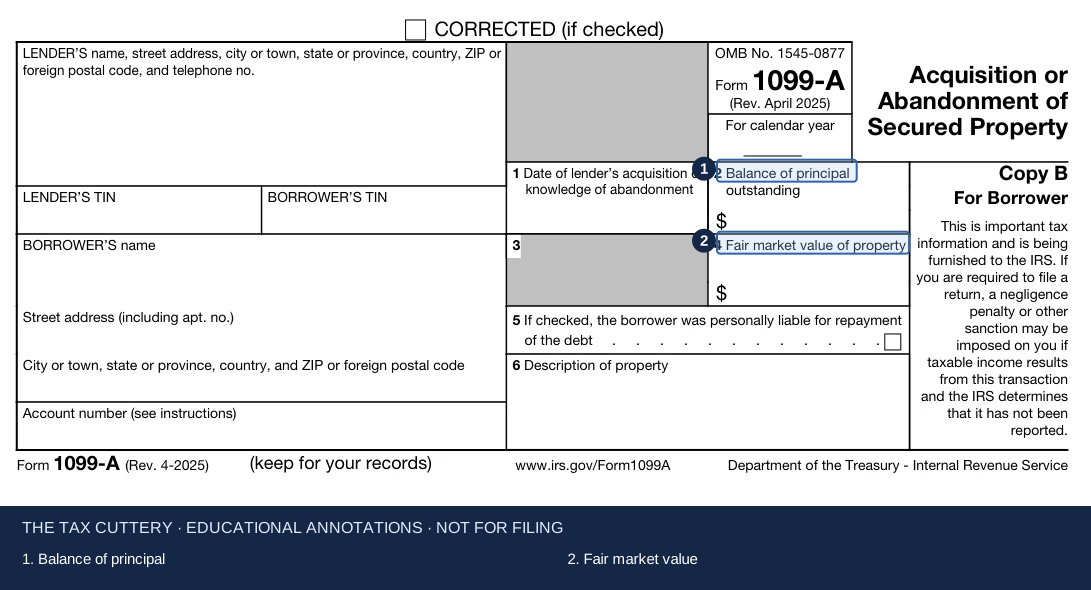
A lender reports acquiring an interest in secured property or knowing that the borrower abandoned it.
What Deserves A Closer Look: A foreclosure or abandonment can involve a sale calculation and a separate debt question. Recourse status, fair market value and adjusted basis matter. Form 1099-A does not by itself establish cancellation-of-debt income.
Keep These Records: Loan balance, closing or foreclosure papers, original cost, improvements and the property’s use.
The principal balance is a loan figure, not automatically taxable income.
Fair market value can affect the disposition calculation; compare it with the debt and your adjusted basis.
Official IRS Copy B · (Rev. April 2025) · Numbered annotations by THE TAX CUTTERY. Open The Official IRS PDF ↗. Educational example; not for filing. Use the correct tax year.
Is Form 1099-A The Same As Canceled Debt?
No. Form 1099-A concerns acquisition or abandonment of secured property. Form 1099-C concerns cancellation of debt. One event can involve both, but the tax calculations are different.
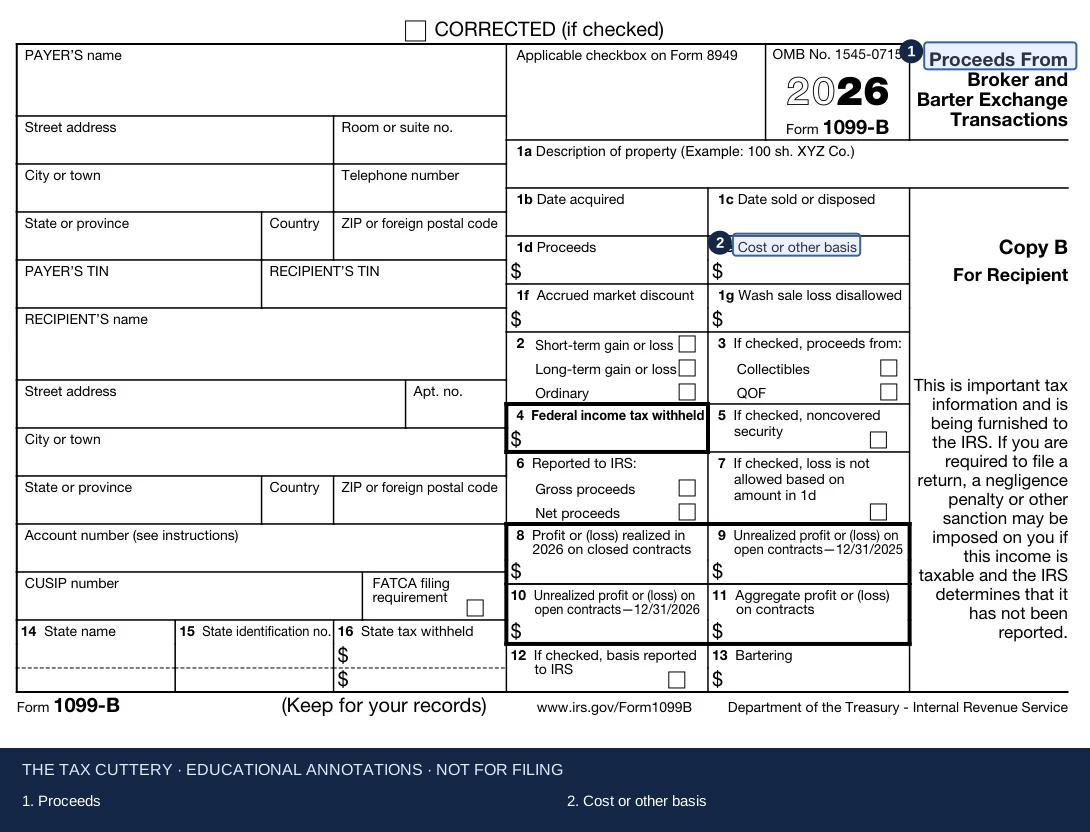
Proceeds From Broker And Barter Exchange Transactions
A broker or barter exchange reports transactions such as securities sales and certain exchanges.
What Deserves A Closer Look: Proceeds are not the same as profit. Basis, holding period, adjustments, wash sales and the type of transaction affect reporting. A consolidated brokerage statement can include several different 1099 forms.
Keep These Records: Complete consolidated statement, supplemental gain/loss pages, acquisition records and prior basis adjustments.
Proceeds describe the reported transaction amount, not the final gain.
Basis may need correction or supporting records, especially for noncovered securities.
Official IRS Copy B · 2026 · Numbered annotations by THE TAX CUTTERY. Open The Official IRS PDF ↗. Educational example; not for filing. Use the correct tax year.
Does The Entire Amount On My 1099-B Become Taxable Income?
Not automatically. Many sales require comparing proceeds with adjusted basis and applying the relevant gain, loss and adjustment rules. Some transactions have different reporting rules, so use the complete broker statement.
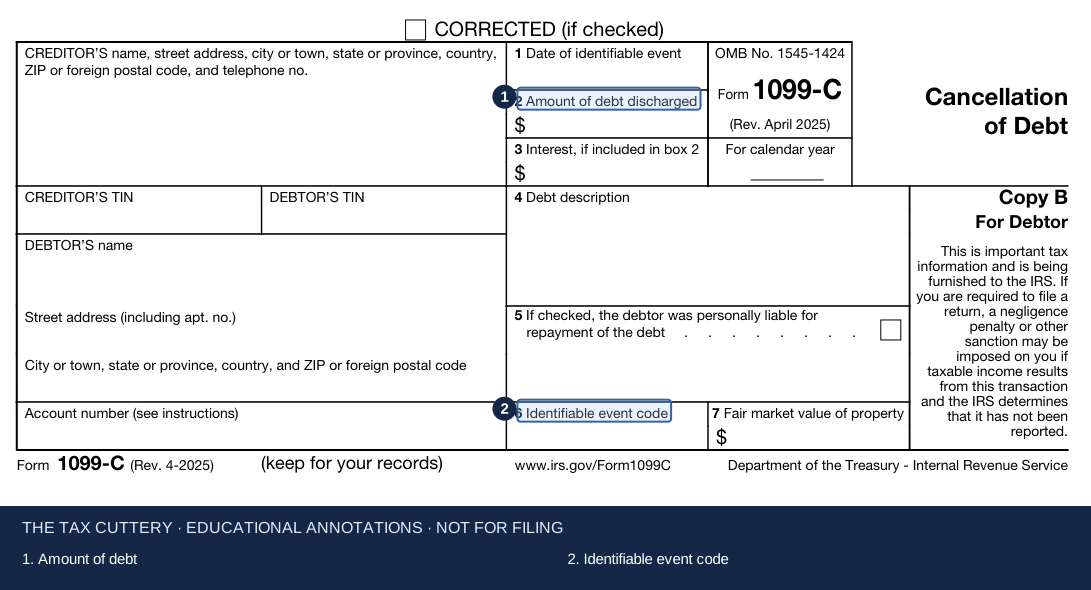
A creditor reports cancellation of a debt when information-reporting rules require it.
What Deserves A Closer Look: Canceled debt may be income, but exclusions and exceptions can apply. Bankruptcy and insolvency require specific facts and may involve Form 982. A form alone does not establish that every dollar is taxable.
Keep These Records: Creditor correspondence, debt history, bankruptcy documents if applicable, and assets and liabilities immediately before cancellation.
The debt amount is the starting point for analysis, not a final tax bill.
The event code helps identify what the creditor reported; reconcile it with what actually happened.
Official IRS Copy B · (Rev. April 2025) · Numbered annotations by THE TAX CUTTERY. Open The Official IRS PDF ↗. Educational example; not for filing. Use the correct tax year.
Do I Always Owe Tax On A 1099-C?
No. Canceled debt can be taxable, but an applicable exception or exclusion can change the result. The debt’s purpose, your financial position and the timing matter; an exclusion may also reduce tax attributes.
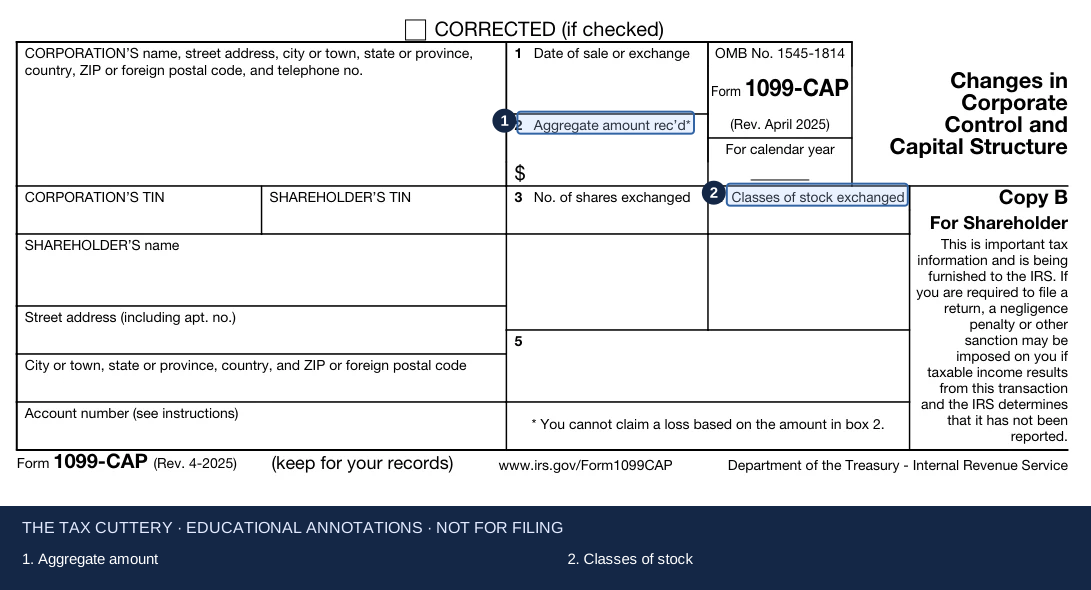
Changes In Corporate Control And Capital Structure
A corporation reports certain changes in control or substantial changes in capital structure involving its shareholders.
What Deserves A Closer Look: Cash, stock and other property may require a gain calculation. A corporate transaction can change the basis and character of what you hold. Keep the transaction notice with any related brokerage statement.
Keep These Records: Merger or exchange notice, original stock basis, cash received and replacement-share details.
The aggregate amount needs to be compared with the transaction terms and your basis.
The stock description identifies the interest involved; match it to your ownership records.
Official IRS Copy B · (Rev. April 2025) · Numbered annotations by THE TAX CUTTERY. Open The Official IRS PDF ↗. Educational example; not for filing. Use the correct tax year.
Is A Corporate Stock Exchange Automatically Tax-Free?
No. The transaction’s legal structure and the cash, stock or other property received determine the treatment. Form 1099-CAP identifies a reportable transaction; it does not independently settle the shareholder’s tax result.
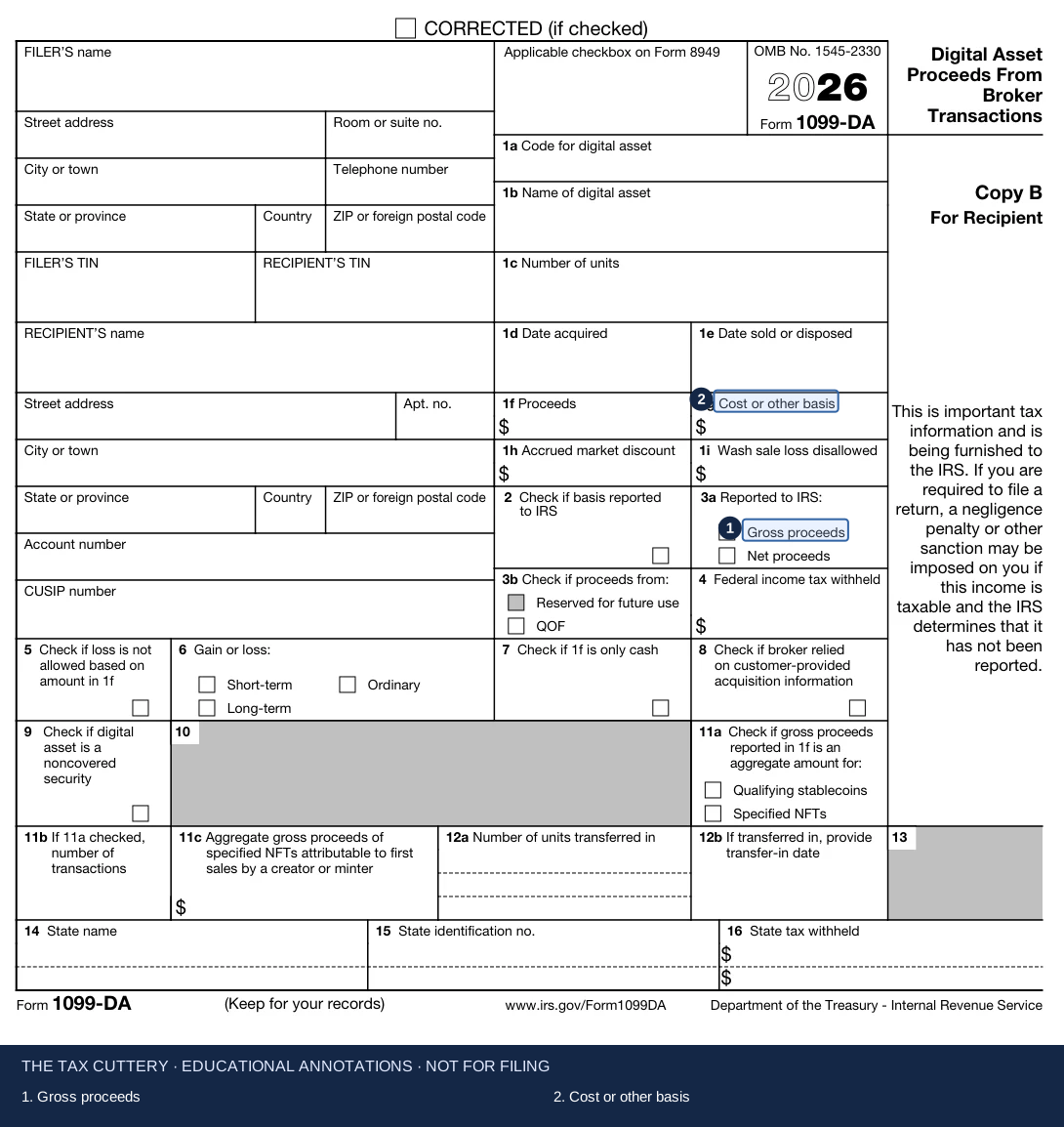
A broker reports covered digital-asset sale or exchange information under the applicable reporting rules.
What Deserves A Closer Look: A 1099-DA is not a complete wallet history. Basis availability and reporting depend on the year and asset rules. Reconcile exchanges, wallets, transfers, fees and prior purchases before calculating taxable gains or losses.
Keep These Records: All exchange exports, wallet histories, acquisition costs, transfers, transaction fees and previous digital-asset reporting.
Reported gross proceeds do not establish the amount of taxable gain.
Check whether basis is reported and whether it agrees with your acquisition history.
Official IRS Copy B · 2026 · Numbered annotations by THE TAX CUTTERY. Open The Official IRS PDF ↗. Educational example; not for filing. Use the correct tax year.
Does A Transfer Between My Own Wallets Create A Taxable Sale?
Moving an asset between wallets you own generally does not itself create a sale, but the actual transaction and any fees still need review. A complete reconciliation helps distinguish transfers from dispositions and prevents duplicate reporting.
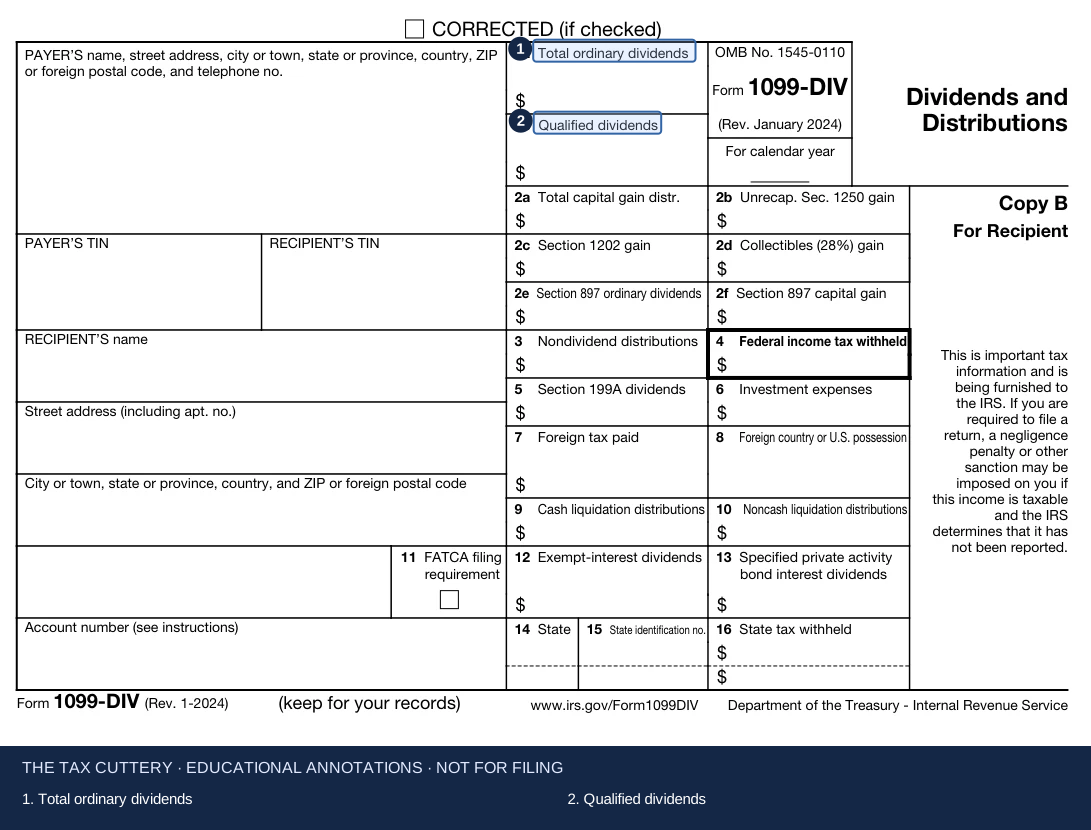
A payer reports dividends and other distributions, including certain capital gain and nondividend distributions.
What Deserves A Closer Look: Ordinary dividends, qualified dividends, capital gain distributions and returns of capital are different categories. Holding-period and other requirements can affect qualified-dividend treatment. Do not add a subtotal to the total that already contains it.
Keep These Records: Full investment statement, corrected forms, holding dates and basis records for nondividend distributions.
Total ordinary dividends generally already include the qualified-dividend amount.
Qualified dividends have separate eligibility requirements and may receive different rates.
Official IRS Copy B · (Rev. January 2024) · Numbered annotations by THE TAX CUTTERY. Open The Official IRS PDF ↗. Educational example; not for filing. Use the correct tax year.
Are Qualified Dividends Added On Top Of Ordinary Dividends?
No. Qualified dividends are generally included within the total ordinary dividends reported. They may qualify for different tax rates when the applicable requirements are met; they are not a second payment to count again.
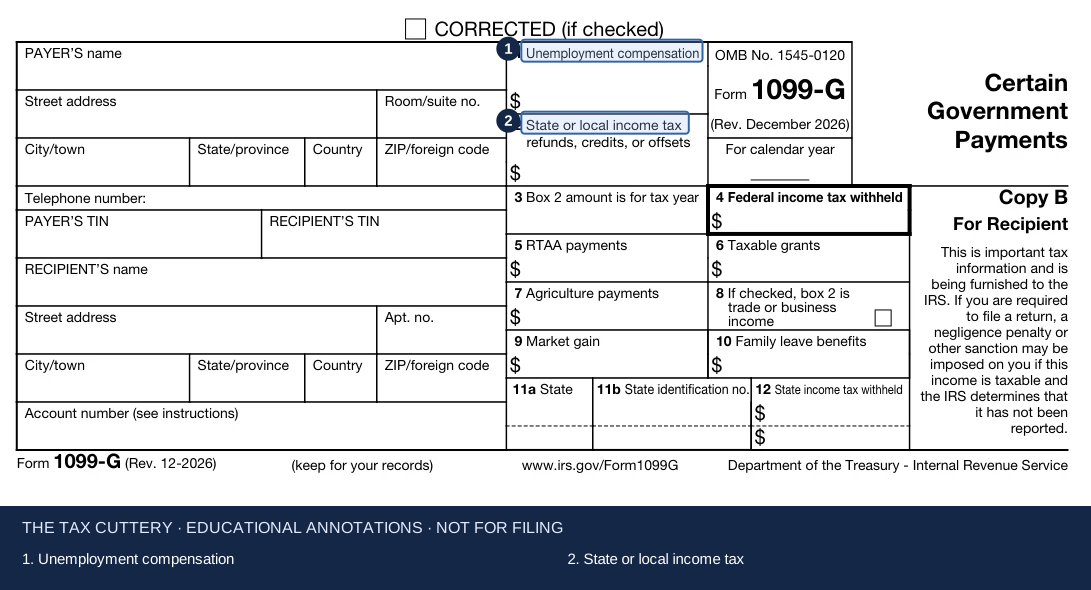
A government payer reports items such as unemployment compensation, certain tax refunds and other specified payments.
What Deserves A Closer Look: The payment type controls the analysis. A state income tax refund is not automatically taxable: the prior deduction and tax benefit matter. Unemployment and other benefit categories have their own rules.
Keep These Records: Government benefit statement, prior-year federal return, state refund records and withholding details.
Unemployment compensation is a different category from a state tax refund.
Review the earlier return before deciding whether a reported tax refund produced taxable recovery income.
Official IRS Copy B · (Rev. December 2026) · Numbered annotations by THE TAX CUTTERY. Open The Official IRS PDF ↗. Educational example; not for filing. Use the correct tax year.
Is My State Tax Refund Always Federal Taxable Income?
No. A state or local income tax refund generally requires a tax-benefit analysis of the earlier deduction. Keep the prior-year return so the refund is not automatically treated as fully taxable.
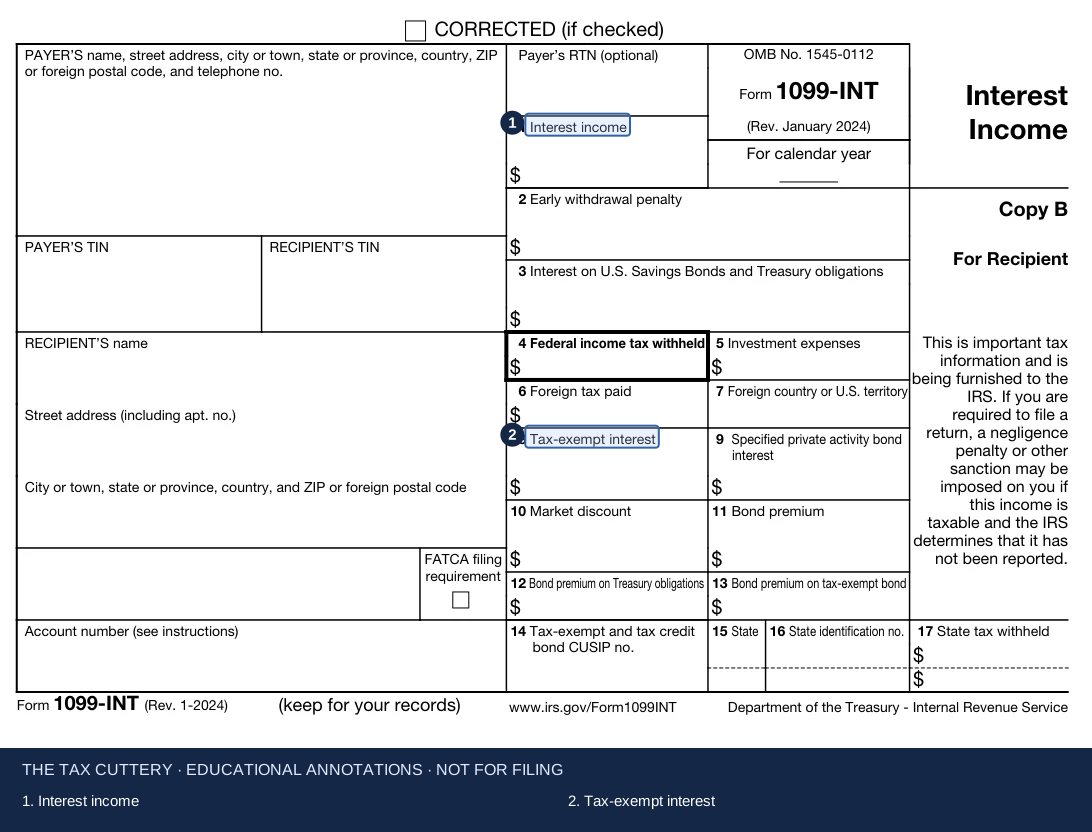
A payer reports interest and related items such as withholding, tax-exempt interest or early-withdrawal penalties.
What Deserves A Closer Look: Taxable interest, Treasury interest and federally tax-exempt interest can have different federal and state consequences. A reporting threshold is not a universal exemption from reporting taxable interest.
Keep These Records: Bank and broker statements, tax-exempt bond details, Treasury records and any corrected statement.
Interest income is a reporting category; check the full statement for other interest boxes.
Federal tax exemption does not mean the amount is irrelevant to every tax calculation.
Official IRS Copy B · (Rev. January 2024) · Numbered annotations by THE TAX CUTTERY. Open The Official IRS PDF ↗. Educational example; not for filing. Use the correct tax year.
Can Tax-Exempt Interest Still Affect My Tax Picture?
Yes. Interest that is exempt from federal income tax may still enter other calculations, including the taxation of Social Security benefits and Medicare income-related premiums. State treatment can also differ.
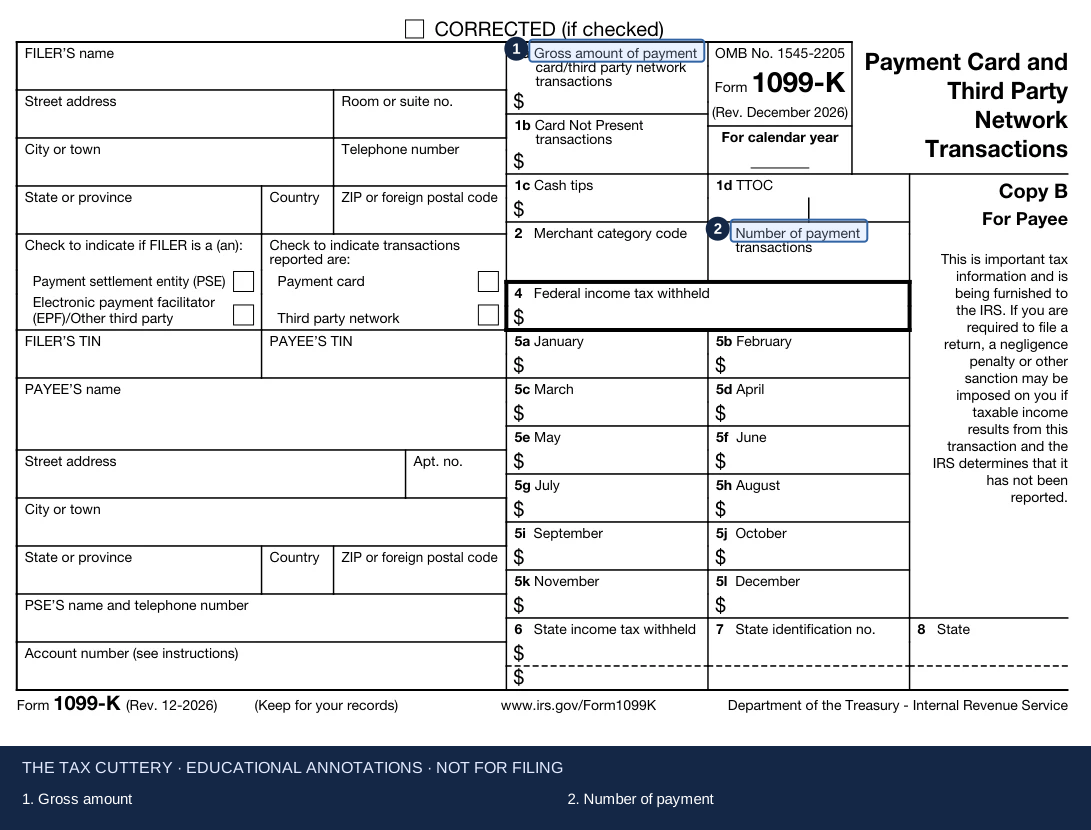
A payment settlement entity reports specified payment transactions processed through its network.
What Deserves A Closer Look: Gross reported payments are not automatically net taxable business income. Reconcile refunds, fees, chargebacks, shared expenses, personal items and any overlap with Forms 1099-NEC or 1099-MISC. Reporting thresholds depend on the payment system and year.
Keep These Records: Processor reconciliation, sales ledger, refunds, platform fees, cost records and other information returns.
Gross payment volume is not a calculation of your profit.
Transaction counts help reconcile the processor’s records with your books.
Official IRS Copy B · (Rev. December 2026) · Numbered annotations by THE TAX CUTTERY. Open The Official IRS PDF ↗. Educational example; not for filing. Use the correct tax year.
Do I Pay Tax Twice If A Customer And A Platform Both Report The Same Payment?
The same income should not be counted twice. Reconcile the forms to the underlying transaction records and report the income once under the correct rules, while retaining support for any duplicate or incorrect reporting.
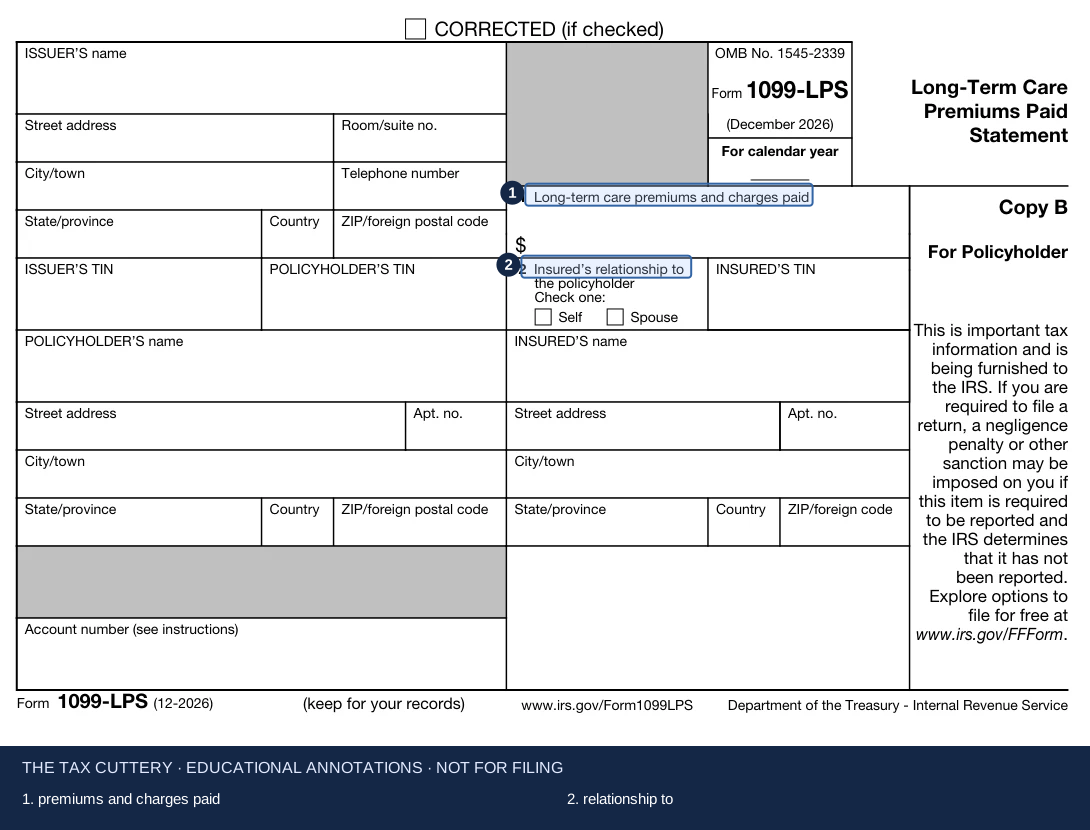
An issuer reports specified premiums and charges paid for certified long-term care insurance under the new reporting framework.
What Deserves A Closer Look: This statement is not Form 1099-LTC and does not report the same thing as long-term care benefit payments. Review the applicable year, policy, retirement-plan distribution and eligibility rules together.
Keep These Records: Insurance policy and premium statement, issuer disclosure, related retirement distribution records and the tax year.
The premium amount must be read with the policy and applicable distribution rules.
The insured’s relationship to the policyholder is a specific fact, not a general coverage certification.
Official IRS Copy B · (December 2026) · Numbered annotations by THE TAX CUTTERY. Open The Official IRS PDF ↗. Educational example; not for filing. Use the correct tax year.
Is Form 1099-LPS The Same As Form 1099-LTC?
No. Form 1099-LPS concerns specified long-term care premiums and charges paid. Form 1099-LTC concerns long-term care and accelerated death benefits. Their names are similar, but the payments and tax questions are different.
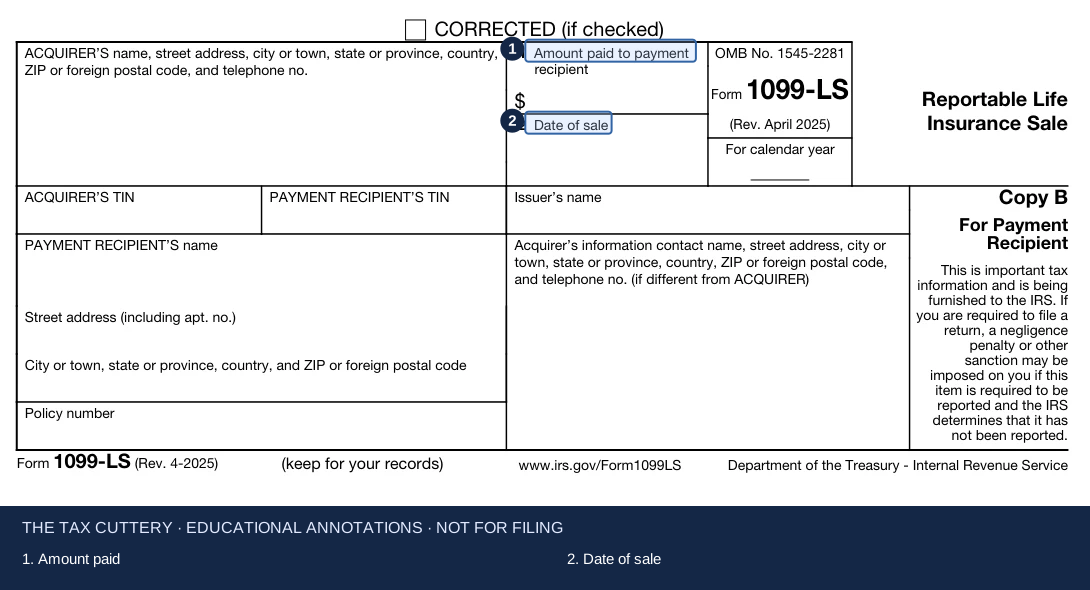
A payer reports amounts paid in a reportable life insurance sale.
What Deserves A Closer Look: The amount paid is not a substitute for the seller’s tax calculation. Contract investment, sale expenses, transaction structure and related Form 1099-SB information can matter.
Keep These Records: Policy sale agreement, premium and basis history, settlement statement and Form 1099-SB if issued.
The reported sale payment must be reconciled with the seller’s records.
The sale date identifies the transaction and relevant reporting year.
Official IRS Copy B · (Rev. April 2025) · Numbered annotations by THE TAX CUTTERY. Open The Official IRS PDF ↗. Educational example; not for filing. Use the correct tax year.
Does Selling A Life Insurance Policy Have Tax Consequences?
It can. A policy sale may generate taxable income or gain depending on the facts. Compare proceeds with the appropriate contract investment and expenses; do not assume treatment is the same as a death benefit.
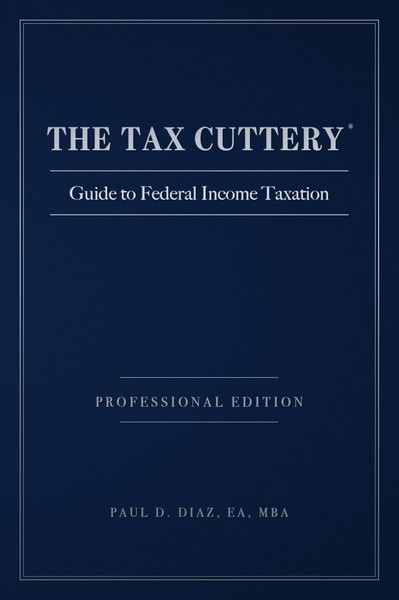
THE TAX CUTTERY® Guide to Federal Income Taxation, Professional Edition
Save Smarter. Prepare Accurately. Defend Better. Three sections connect planning, preparation and resolution—so the next tax document arrives with more context and fewer unanswered questions.
The Guide is optional for return preparation and required for Tax Advisory. No purchase is required to start the free initial consultation. Any professional work is separately scoped and engaged.
12 / 22 · The 1099 Directory
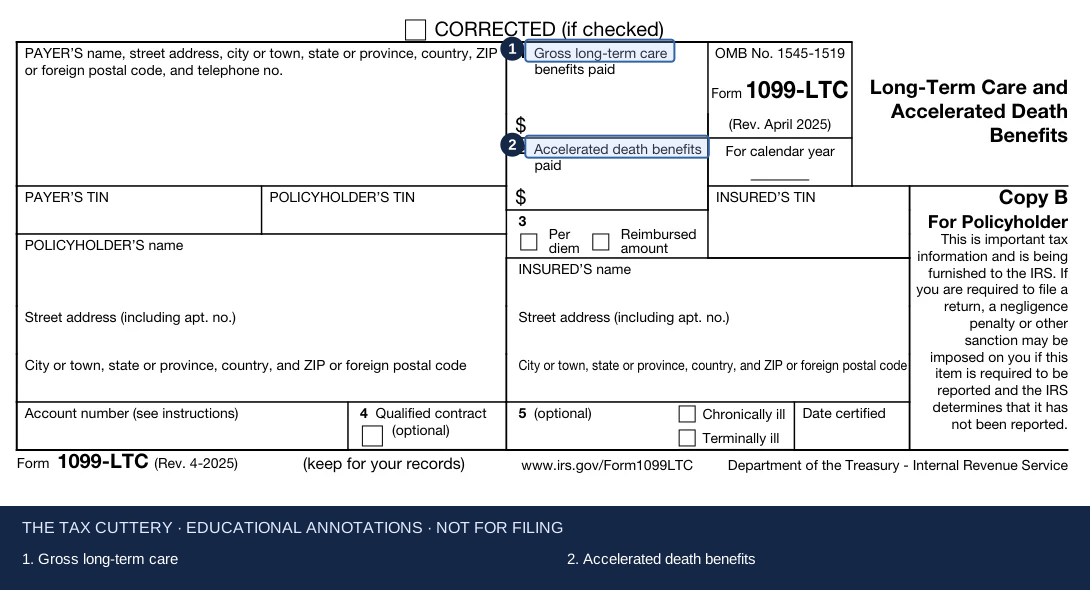
FORM 1099-LTC
Long-Term Care And Accelerated Death Benefits
An insurer or other payer reports long-term care benefits or accelerated death benefits.
What Deserves A Closer Look: Receiving this form does not by itself make the benefits taxable. Policy type, reimbursement versus per-diem benefits, qualification and other payments can affect the result and whether Form 8853 is needed.
Keep These Records: Policy details, benefit statements, care expenses, reimbursements and applicable medical certifications.
Gross long-term care benefits do not automatically equal taxable benefits.
Accelerated death benefits are a separate reported category with their own qualifying rules.
Official IRS Copy B · (Rev. April 2025) · Numbered annotations by THE TAX CUTTERY. Open The Official IRS PDF ↗. Educational example; not for filing. Use the correct tax year.
Are All Long-Term Care Benefits Taxable?
No. Qualified benefits may be excluded when the applicable requirements are met. Per-diem payments, reimbursements, policy status and other coverage require review before deciding the taxable amount.
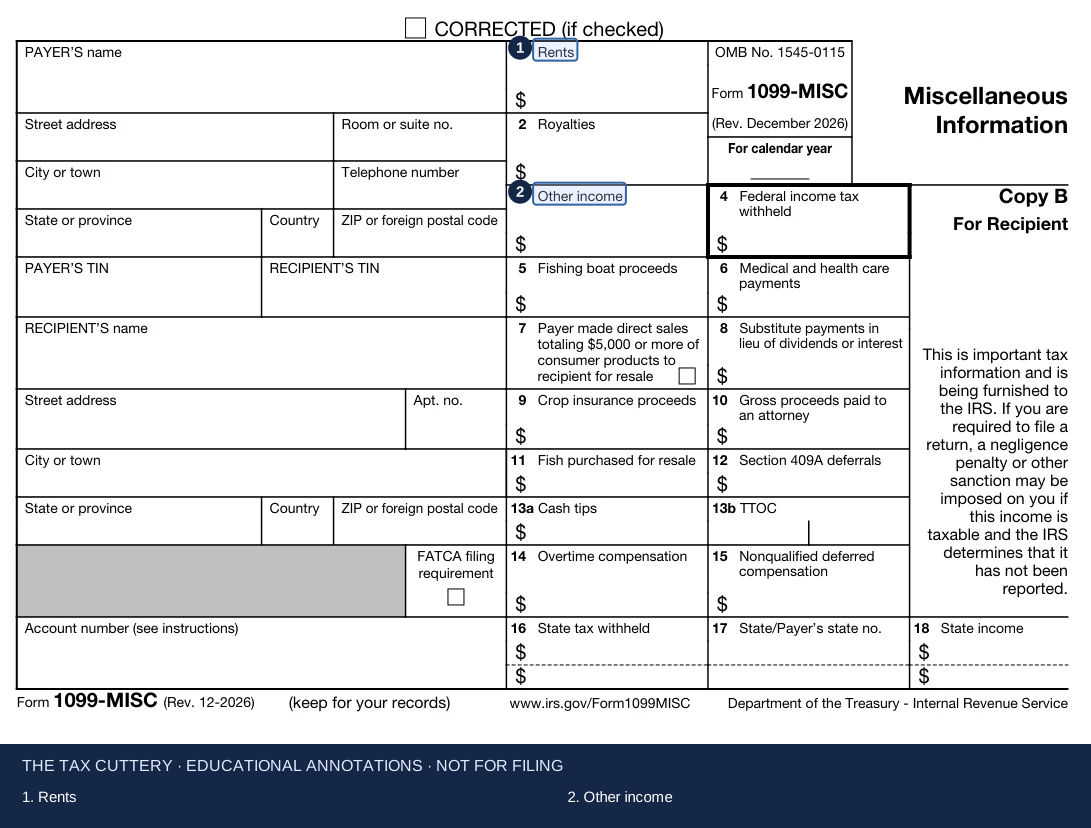
A payer reports categories such as rents, royalties and other specified payments.
What Deserves A Closer Look: The box matters. Rents, royalties, prizes and other income do not all belong in the same place on a return. Form 1099-MISC and Form 1099-NEC are not interchangeable.
Keep These Records: Lease or royalty agreements, payer details, payment ledger, expenses and corrected forms.
Rental payments need to be matched with the property and activity involved.
Other income is a reporting label; its tax character still depends on the facts.
Official IRS Copy B · (Rev. December 2026) · Numbered annotations by THE TAX CUTTERY. Open The Official IRS PDF ↗. Educational example; not for filing. Use the correct tax year.
Does Every 1099-MISC Mean I Am Self-Employed?
No. The nature of the payment and the underlying activity determine the treatment. Rents, royalties and other payments can follow different rules; the form’s presence alone does not establish a trade or business.
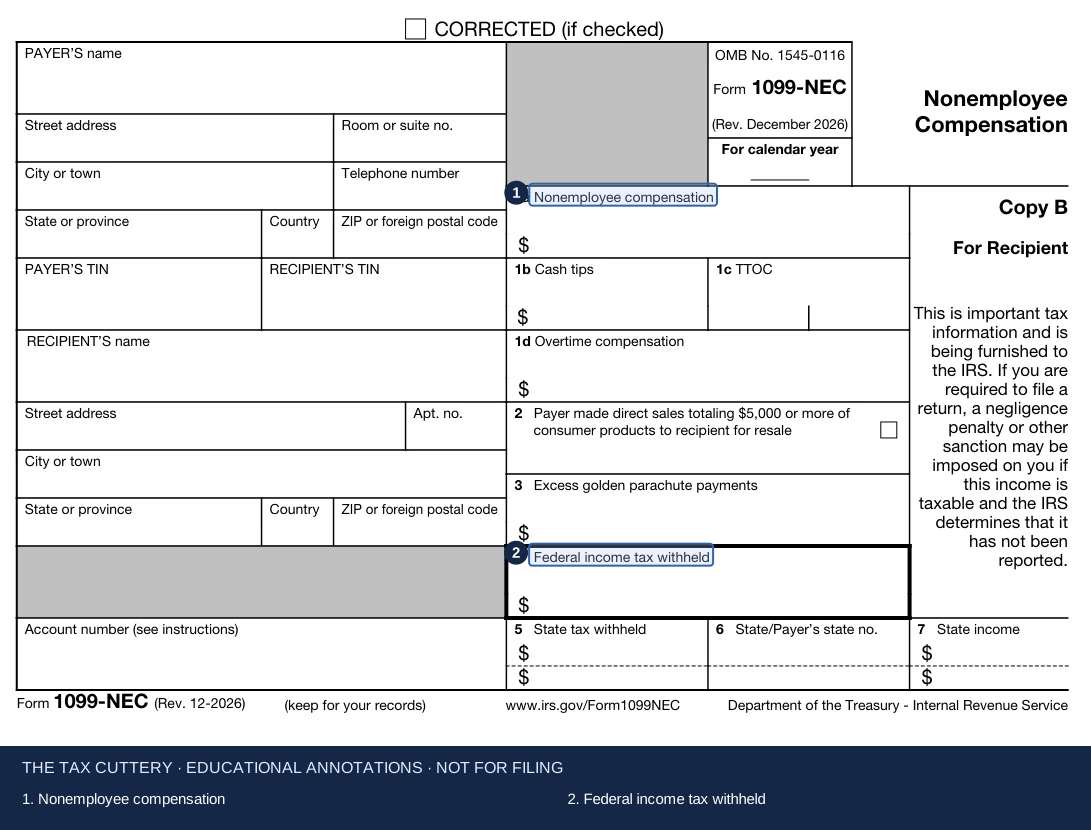
A payer reports compensation for services performed by a person who is not treated as an employee for the payment.
What Deserves A Closer Look: A 1099-NEC does not calculate business profit or settle worker classification. Track actual receipts and allowable expenses, consider self-employment tax and plan for estimated payments when applicable.
Keep These Records: Contracts, all business receipts, expense records, mileage support and estimated tax payments.
Compensation is generally a gross receipt to reconcile with your books.
Withholding, if present, is a separate payment-credit question; it is not a business expense.
Official IRS Copy B · (Rev. December 2026) · Numbered annotations by THE TAX CUTTERY. Open The Official IRS PDF ↗. Educational example; not for filing. Use the correct tax year.
Does Receiving A 1099-NEC Automatically Make Worker Classification Correct?
No. Worker classification depends on the actual relationship and applicable rules. Receiving a form or signing a contractor agreement does not resolve the issue by itself.
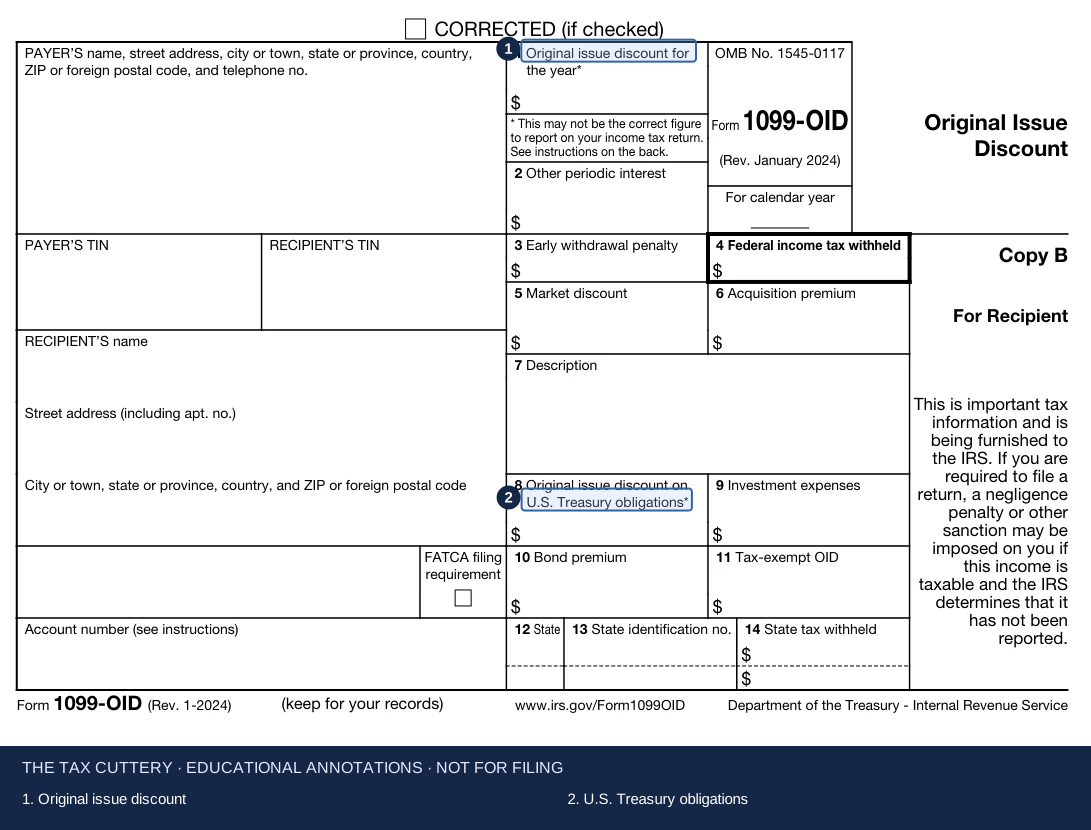
A payer reports original issue discount and related information for debt instruments.
What Deserves A Closer Look: Taxable interest can accrue even without a matching cash payment. Acquisition premium, bond premium, market discount and tax-exempt instruments may change the calculation.
Keep These Records: Purchase date and price, issue details, broker adjustments and prior-year basis records.
The reported original issue discount may need adjustments for your purchase history.
Treasury OID has its own reporting category and can have different state treatment.
Official IRS Copy B · (Rev. January 2024) · Numbered annotations by THE TAX CUTTERY. Open The Official IRS PDF ↗. Educational example; not for filing. Use the correct tax year.
Can I Have Interest Income Without Receiving Cash?
Yes. Original issue discount can be included as interest over time under applicable rules even before cash is received. Purchase history and adjustments matter, so retain the full broker statement.
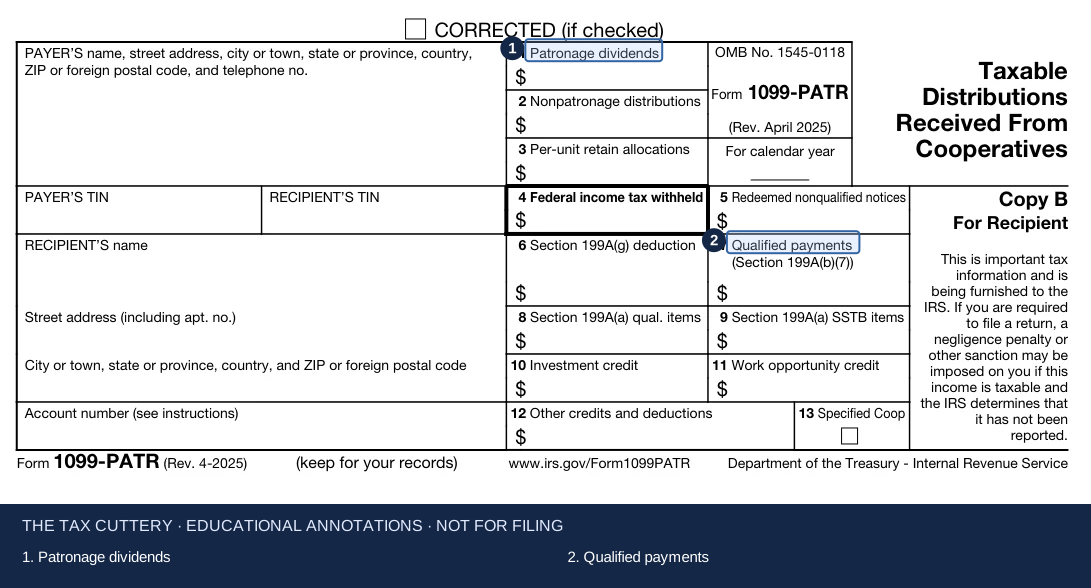
A cooperative reports patronage dividends and other specified distributions to a patron.
What Deserves A Closer Look: Business use and personal use can lead to different treatment. Qualified payments and potential cooperative-related deductions require separate analysis; the form’s total is not a ready-made tax deduction.
Keep These Records: Cooperative statements, purchase and business-use records, qualified-payment information and related business return.
Patronage dividends should be connected to the underlying purchases and activity.
Qualified payments identify information relevant to separate cooperative tax rules.
Official IRS Copy B · (Rev. April 2025) · Numbered annotations by THE TAX CUTTERY. Open The Official IRS PDF ↗. Educational example; not for filing. Use the correct tax year.
Is A Cooperative Distribution Always Business Income?
Not necessarily. The treatment can depend on the purchases or activities that generated it and whether they were for business, capital or personal use. Reconcile the distribution with those records.
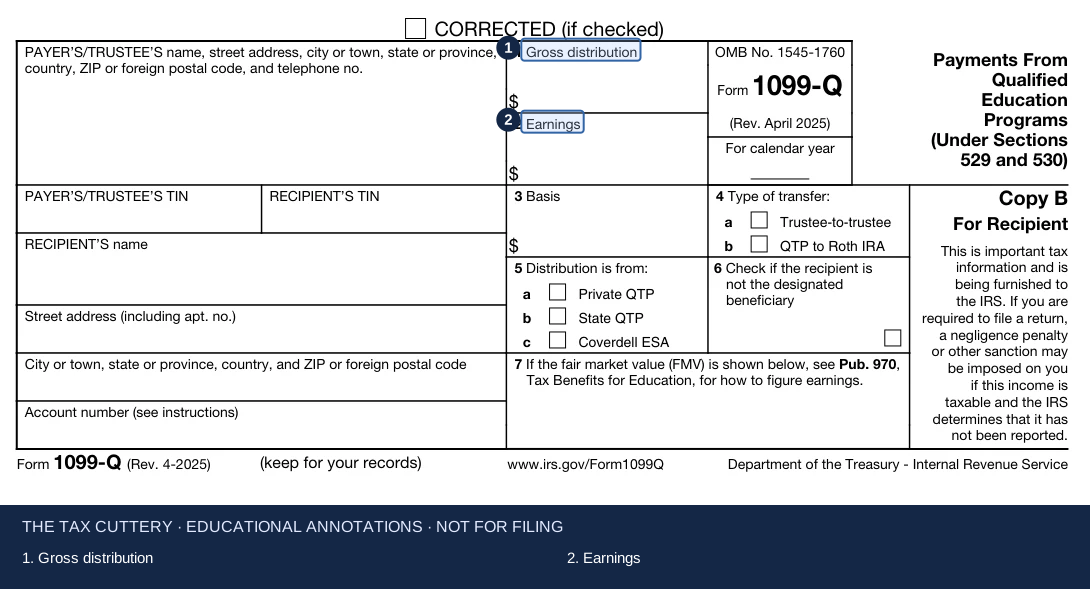
A payer reports distributions from a qualified tuition program or Coverdell education savings account.
What Deserves A Closer Look: A distribution is not automatically taxable and not automatically excluded. Match expenses, calendar-year timing, scholarships and education credits. The same expense cannot support overlapping tax benefits improperly.
Keep These Records: School bills, payment dates, scholarships, education-credit records and distribution details.
Gross distribution includes more than just the potentially taxable earnings.
Earnings must be coordinated with qualified expenses and other education benefits.
Official IRS Copy B · (Rev. April 2025) · Numbered annotations by THE TAX CUTTERY. Open The Official IRS PDF ↗. Educational example; not for filing. Use the correct tax year.
Does A 1099-Q Mean My Education Withdrawal Is Taxable?
No. The result depends on eligible expenses and the applicable program rules. Earnings can become taxable when the distribution is not supported by qualifying expenses after coordinating other education benefits.
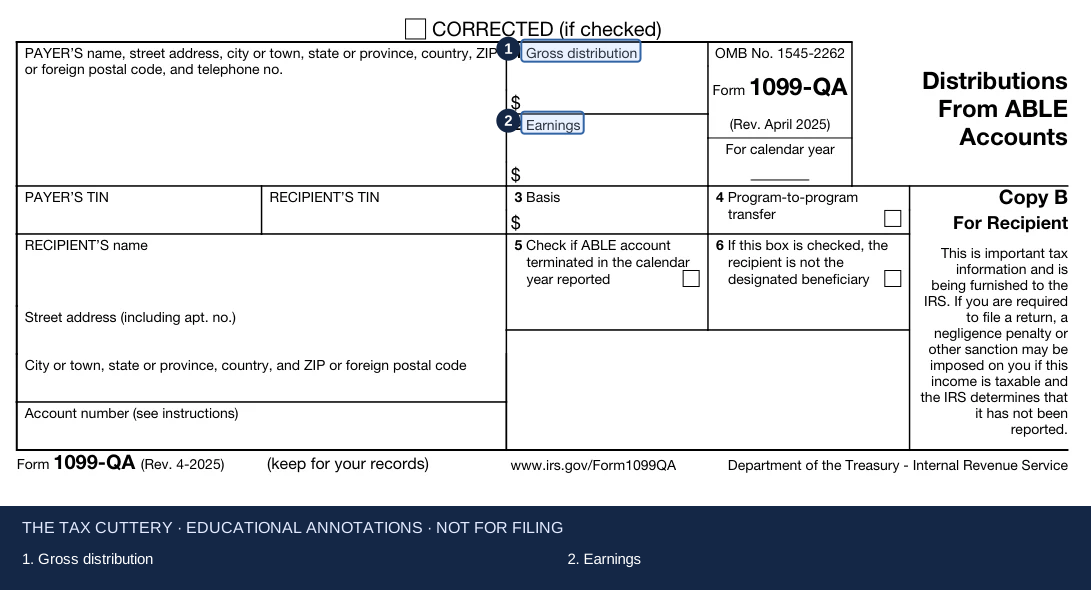
An ABLE program reports distributions from an eligible individual’s ABLE account.
What Deserves A Closer Look: Qualified disability expenses and other program rules determine treatment. Keep expense and distribution records; Form 1099-QA is different from an education-program Form 1099-Q.
Keep These Records: ABLE statements, disability-expense receipts, distribution dates and any rollover or transfer records.
The gross distribution should be reconciled with ABLE account activity.
The earnings component needs to be matched with the applicable exclusion rules.
Official IRS Copy B · (Rev. April 2025) · Numbered annotations by THE TAX CUTTERY. Open The Official IRS PDF ↗. Educational example; not for filing. Use the correct tax year.
Is Every ABLE Account Withdrawal Tax-Free?
Not automatically. Tax treatment depends on qualified disability expenses and other ABLE rules. A nonqualified distribution can make earnings taxable and may create additional tax unless an exception applies.
Pensions, Annuities, Retirement Plans, IRAs And Insurance Distributions
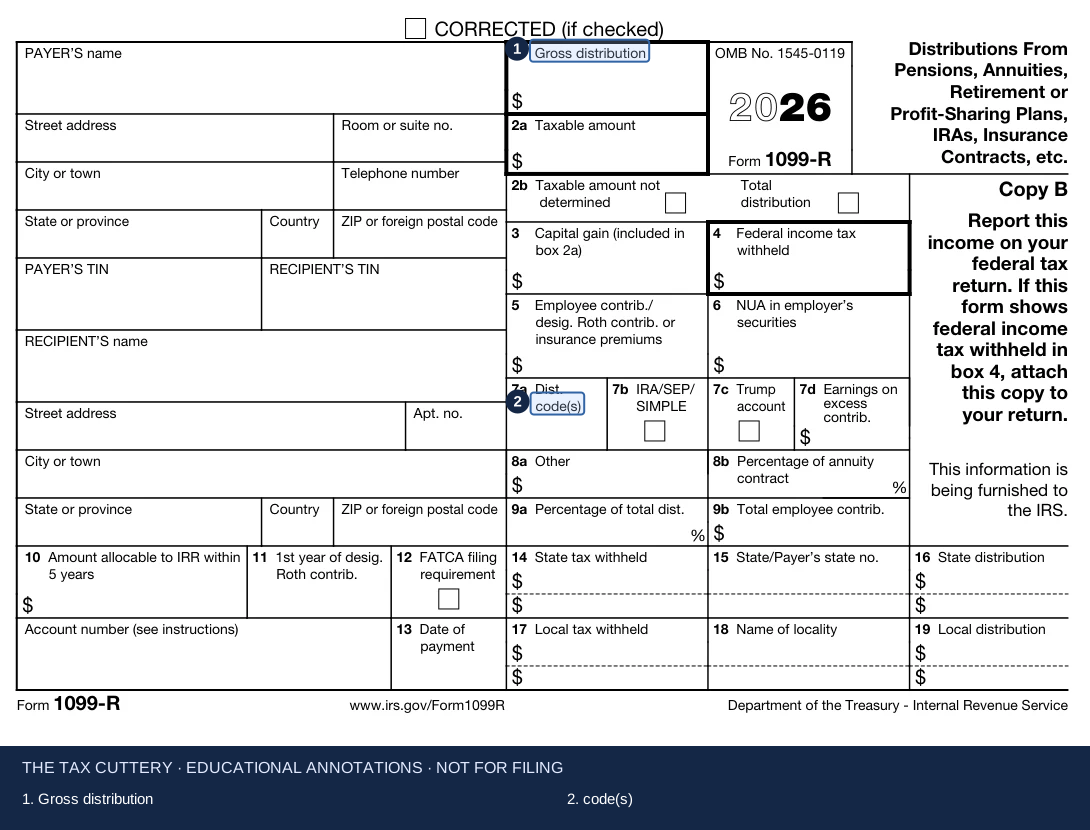
A payer reports distributions from retirement arrangements, annuities and certain insurance contracts.
What Deserves A Closer Look: Gross distribution, taxable amount and distribution code answer different questions. Rollovers, Roth rules, basis and early-distribution exceptions can change the result. The 2026 form uses Box 7a for distribution codes.
Keep These Records: Full 1099-R, account type, basis history, rollover dates, age and support for any claimed exception.
Gross distribution and taxable income are separate figures; basis and rollover facts can matter.
In the 2026 revision, Box 7a contains distribution codes. Numeric, alphabetic and permitted combinations exist.
Official IRS Copy B · 2026 · Numbered annotations by THE TAX CUTTERY. Open The Official IRS PDF ↗. Educational example; not for filing. Use the correct tax year.
Does Code 1 Always Mean I Owe The Early-Distribution Additional Tax?
No. Code 1 means the payer reports an early distribution with no known exception. A taxpayer who actually qualifies for an exception may need Form 5329 to claim it. Code 2 does not by itself mean the distribution is exempt from ordinary income tax.
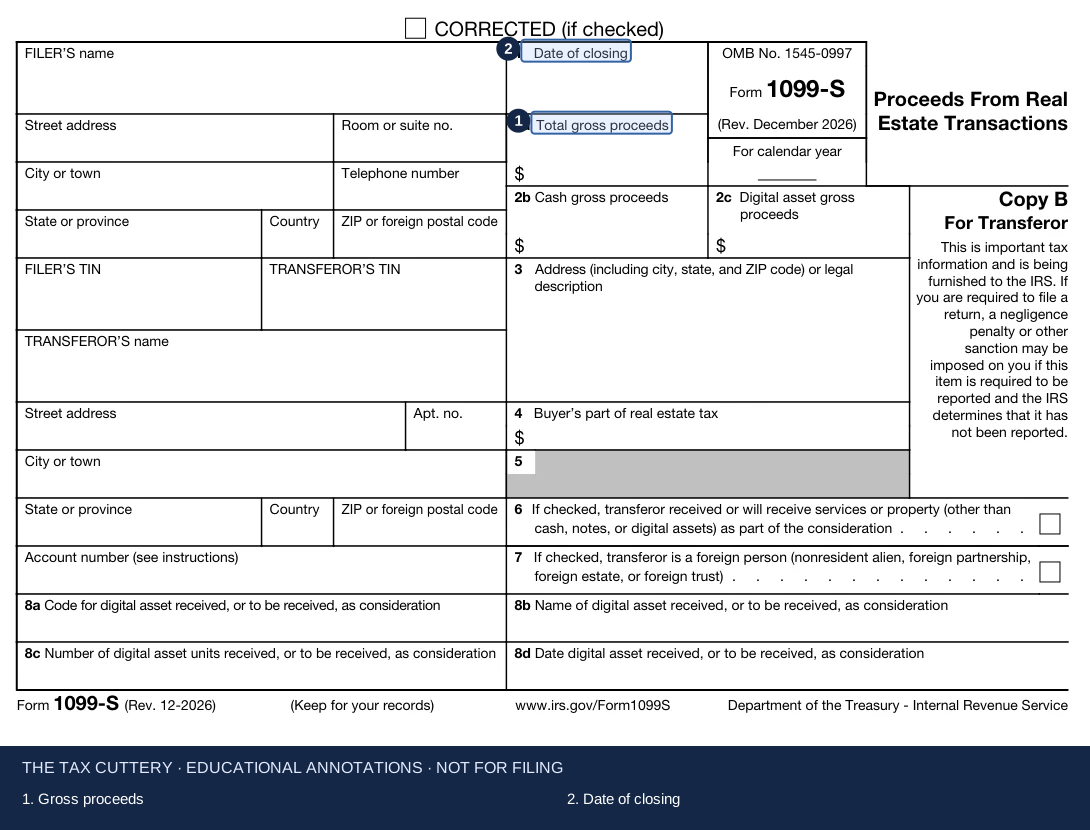
A reporting person reports gross proceeds and other information from certain real estate transactions.
What Deserves A Closer Look: The sales price is not your gain. Basis, improvements, selling expenses, depreciation and possible exclusions or deferral rules matter. Receiving a 1099-S does not automatically mean a home sale is fully taxable.
Keep These Records: Purchase and sale closing statements, improvement costs, occupancy history, depreciation and ownership details.
Gross proceeds are a starting point, not the taxable profit on the sale.
The closing date helps establish the reporting period and relevant transaction history.
Official IRS Copy B · (Rev. December 2026) · Numbered annotations by THE TAX CUTTERY. Open The Official IRS PDF ↗. Educational example; not for filing. Use the correct tax year.
Does A 1099-S Mean I Owe Tax On My Entire Home Sale?
No. Gross proceeds are different from gain. Determine adjusted basis and selling costs, then evaluate any home-sale exclusion or other applicable rule based on the property and your actual facts.
Distributions From An HSA, Archer MSA Or Medicare Advantage MSA
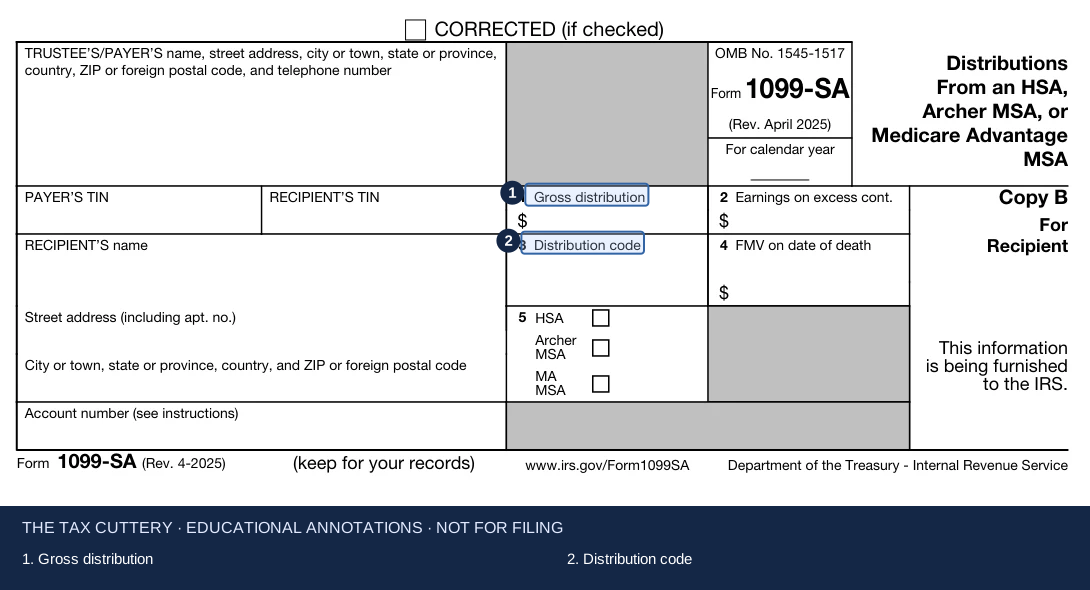
A trustee or payer reports distributions from a health savings or medical savings account.
What Deserves A Closer Look: Qualified medical expenses and the account rules determine treatment. A debit-card payment is not proof that an expense qualifies. HSA distributions generally require coordination with Form 8889; MSA reporting differs.
Keep These Records: Account statements, unreimbursed medical receipts, coverage details and prior reimbursements.
Gross distributions must be reconciled with qualifying expenses and account records.
The code identifies the reported distribution type; it does not replace expense substantiation.
Official IRS Copy B · (Rev. April 2025) · Numbered annotations by THE TAX CUTTERY. Open The Official IRS PDF ↗. Educational example; not for filing. Use the correct tax year.
Does An HSA Debit Card Make Every Purchase Tax-Free?
No. Eligibility depends on the expense and the account rules, not which card paid it. Keep receipts and make sure the expense was not reimbursed elsewhere or used improperly for another tax benefit.
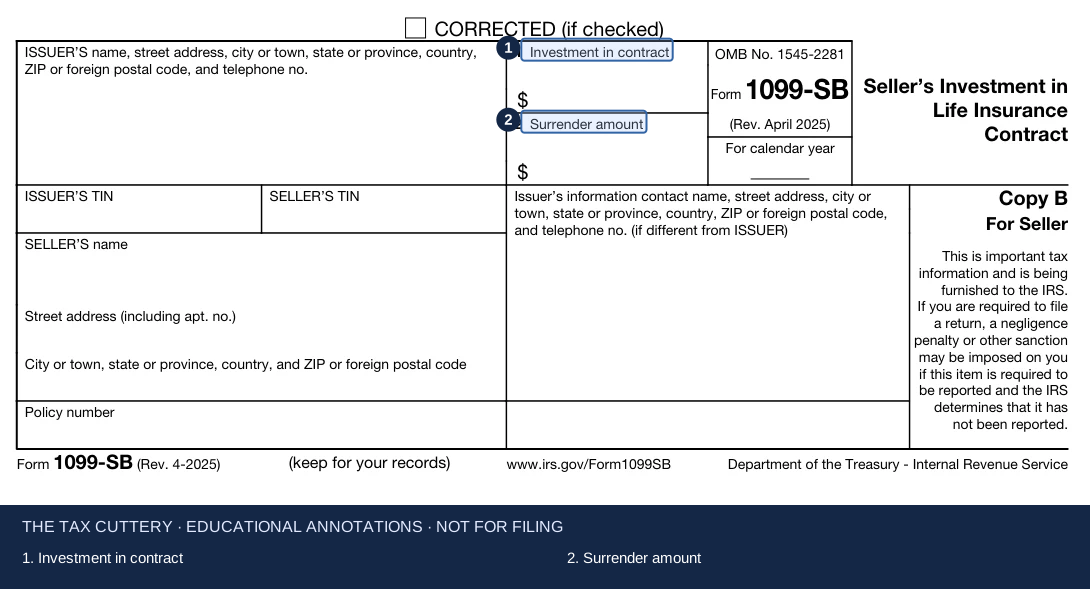
An insurer reports the seller’s investment in a life insurance contract and other required contract information.
What Deserves A Closer Look: This is different from Form 1099-LS, which reports sale payments. Contract investment and surrender information help analyze the seller’s transaction but do not independently calculate the final tax.
Keep These Records: Complete premium and contract history, sale agreement, issuer statement and related Form 1099-LS.
Investment in the contract is a tax-analysis input that must be reconciled with the policy history.
Surrender information is different from the amount paid in a policy sale.
Official IRS Copy B · (Rev. April 2025) · Numbered annotations by THE TAX CUTTERY. Open The Official IRS PDF ↗. Educational example; not for filing. Use the correct tax year.
Why Might A Policy Sale Produce Both 1099-LS And 1099-SB?
The forms report different parts of the transaction: sale payments and contract-investment information. Use them together with the seller’s records to determine the appropriate income or gain treatment.
Form 1099-H reported Health Coverage Tax Credit advance payments. The credit expired after 2021, and the IRS says Form 1099-H can no longer be filed starting in 2026. Keep older records for their relevant years; this is not a current health-insurance reporting form.
SSA-1099 reports Social Security benefits. Whether benefits are taxable depends on your broader income and filing situation. “Up to 85% taxable” describes the possible portion included in income—not an 85% tax rate. Supplemental Security Income (SSI) is different and is not taxable.
Your payer reports what it knows. Your return must account for the facts and any exception you actually qualify for. For qualifying retirement-plan substantially equal periodic payments, an early-distribution additional-tax exception can apply while the taxable portion remains ordinary income. Form 5329 and Form 1099-R serve different purposes; one does not replace the other.
Retirement-plan rules under section 72(t) and nonqualified-annuity rules under section 72(q) are not interchangeable. Changing a payment arrangement can have serious consequences. Check the applicable year and arrangement before acting.
A 1099 is an information return used to report a particular category of payment, transaction or account activity. The suffix and the individual boxes matter. Receiving one does not establish that every reported dollar is taxable income or subject to the same tax rules.
Do I Need To Report Income If I Did Not Receive A 1099?
A payer’s reporting threshold is not a general exemption for the recipient. Taxable income may need to be reported even when no form arrives. Use your complete records and the rules for that income, rather than relying only on information returns received.
What If My 1099 Is Wrong?
Contact the issuer to request a correction and retain your request, the original form, any corrected form and supporting records. Do not simply change a payer’s form yourself or ignore a deadline. The proper return treatment depends on the form, error and available facts.
What If Two Forms Report The Same Money?
Reconcile the forms to your books and underlying transactions. The same income should not be counted twice. Keep support for duplicates, gross-to-net differences and any issuer correction instead of deleting a form without an explanation.
Is The Amount On A 1099 My Profit?
Not necessarily. Forms can report gross proceeds, gross payments, distributions, interest, benefits or other categories. Business expenses, adjusted basis, exclusions and other rules can change the taxable amount. The form category is the starting point.
What Is The Difference Between 1099-MISC And 1099-NEC?
Form 1099-NEC generally concerns nonemployee compensation for services. Form 1099-MISC reports specified other categories, such as rents and royalties. The correct box and the underlying payment determine reporting; the forms are not interchangeable.
Is A 1099 The Same As A W-2?
No. Form W-2 reports employee wages and related information. A Form 1099 reports its own category of payments or transactions. Worker classification depends on the actual relationship and applicable rules, not just the document a payer chooses.
What Is A Consolidated 1099 Statement?
A financial institution may combine several information returns into one statement package, such as Forms 1099-B, 1099-DIV and 1099-INT. Provide the complete package, including supplemental pages and corrections, rather than only its cover or summary.
Can I Upload My Tax Forms On This Public Page?
No. This is a public educational directory. Do not post Social Security numbers, account numbers or tax forms publicly. Start the free consultation; the firm’s secure intake and document collection follow through the appropriate private process.
Does The 1099-R Early-Distribution Exception Make The Withdrawal Income-Tax-Free?
No. An exception to the early-distribution additional tax does not necessarily exclude the taxable portion from ordinary income. For example, qualifying substantially equal periodic payments can meet an additional-tax exception while remaining taxable to the extent otherwise includible.
Are These Blank Form Images Ready To File?
No. They are educational reproductions of official IRS recipient copies with firm annotations. Use the form and instructions for the correct tax year and a proper filing process. A revision date is not always the year the taxpayer received the payment.
Do I Have To Buy The Book Before Starting?
No purchase is required to start the free initial tax consultation. The Guide is optional for return preparation and required for Tax Advisory. Any preparation, research, representation or written advice is separately scoped and engaged; an initial consultation is not a free written tax opinion.
The 564-page hardcover Guide.
The Book Behind The Practice
Understand The Form. See The Bigger Picture.
THE TAX CUTTERY® Guide to Federal Income Taxation, Professional Edition
Save Smarter. Prepare Accurately. Defend Better. Three sections connect planning, preparation and resolution—so the next tax document arrives with more context and fewer unanswered questions.
The Guide is optional for return preparation and required for Tax Advisory. No purchase is required to start the free initial consultation. Any professional work is separately scoped and engaged.
Your Next Step
Bring The Form. Tell Us The Story.
Tell us which tax year, which form and what concerns you. The free prerecorded consultation collects the context behind the records. Secure intake and document collection follow through the right private path.
No purchase is required to start. Return preparation, Tax Advisory, research and representation require their own defined engagement. A live appointment is scheduled separately when needed.
Go To The Source.
Every annotated form above links to its official IRS PDF. Some current forms use a continuous-use revision date; the date printed on a form is not automatically the payment year. Where a final form for a newer year is published, confirm that it applies to the return being prepared.
Reviewed October 20, 2026. Official source forms are U.S. government works; THE TAX CUTTERY’s annotations and explanations are original educational material. This directory is not an IRS filing portal and does not determine your individual tax liability. No personal answers or documents are collected here.